 how-to
Choosing the Right Storage Unit Size: 2026 Guide
Table of Contents
- Start With an Inventory, Not a Guess
- Storage Unit Size Chart: Dimensions and What Fits
- Storage Unit Size for a One-Bedroom Apartment
- 10x10 vs. 10x15 Storage Unit: Which Fits Your Move?
- Storage Unit Packing Tips That Protect Your Belongings
- Cost, Climate, and Access: The Trade-Offs That Decide the Size
- Conclusion
- Frequently Asked Questions
Last Updated: October 18, 2026
Start With an Inventory, Not a Guess
Guessing at storage unit size usually means paying for space you never fill or running out of room on moving day.
Choosing the right storage unit size starts with a list, not a hunch. The people who measure first rent once.
The simple rule: count what you own before you compare unit dimensions.
The Room-by-Room Worksheet
Walk your home one room at a time and list every item headed for storage, grouped by type:
- Furniture: couch, mattress, dressers, tables, chairs
- Appliances: fridge, washer, dryer, microwave
- Boxes: label each one by room and rough size
Snap a photo of each pile, those photos settle the question fast in the rental office.
Turning Boxes Into Cubic Feet
Volume is what actually matters. A storage unit's capacity is measured in cubic feet: length times width times height.
Use rough estimates to keep it simple:
- A medium moving box holds about 3 cubic feet
- A couch eats roughly 50 cubic feet
- A queen mattress and box spring take about 60 cubic feet
Add it up, then add 10% for walkway space. That total points you toward a unit size.
Storage Unit Size Chart: Dimensions and What Fits
A storage unit size chart turns your inventory list into a decision. The table below covers the standard sizes and what each one holds.
| Unit Size | Square Feet | Roughly the Size Of | What Fits |
|---|---|---|---|
| 5x5 | 25 | A small closet | Boxes, seasonal decor, small furniture |
| 5x10 | 50 | A walk-in closet | Studio apartment contents, mattress, boxes |
| 10x10 | 100 | A one-car garage | One-bedroom apartment, small couch, appliances |
| 10x15 | 150 | A large bedroom | Two-bedroom home, full furniture set |
| 10x20 | 200 | A one-car garage and a half | Three-bedroom home, vehicle storage |
| 10x30 | 300 | A two-car garage | Large home, business inventory, equipment |
Small, Medium, and Large Units at a Glance
Small units (5x5 and 5x10) suit seasonal gear, documents, and apartment overflow.
Medium units (10x10 and 10x15) handle most moves: a 10x10 fits a one-bedroom apartment, a 10x15 a two-bedroom home with room to walk.
Large units (10x20 and 10x30) serve families, movers, and business owners. A 10x30 holds the contents of a three-bedroom house plus a vehicle or a pallet of inventory.
Storage Unit Size for a One-Bedroom Apartment
A 5x10 works if you're storing only the big pieces; a 10x15 gives breathing room if you also have appliances or a bike.
A one-bedroom runs about 600 to 700 square feet, but most of that is open air, not belongings, which is why a 100-square-foot unit can hold it.
Stack high and keep the walkway clear, that makes a 10x10 feel roomy instead of cramped.
10x10 vs. 10x15 Storage Unit: Which Fits Your Move?
The 10x10 vs. 10x15 storage unit decision comes down to one question: do you need a walkway, or just a place to put things?
A 10x10 unit holds about 1,000 cubic feet, a one-bedroom apartment's furniture and boxes, but the aisles get tight.
A 10x15 unit holds about 1,500 cubic feet, the difference between squeezing past boxes and walking down the middle.
| Factor | 10x10 | 10x15 |
|---|---|---|
| Best for | One-bedroom apartment | Two-bedroom home |
| Walkway space | Minimal | Comfortable |
| Access ease | Tight for large items | Easy for furniture moves |
| Business use | Small inventory | Overflow stock, equipment |
If you're unsure, ask about upgrading later. A slightly larger unit costs less than a second move.
Storage Unit Packing Tips That Protect Your Belongings
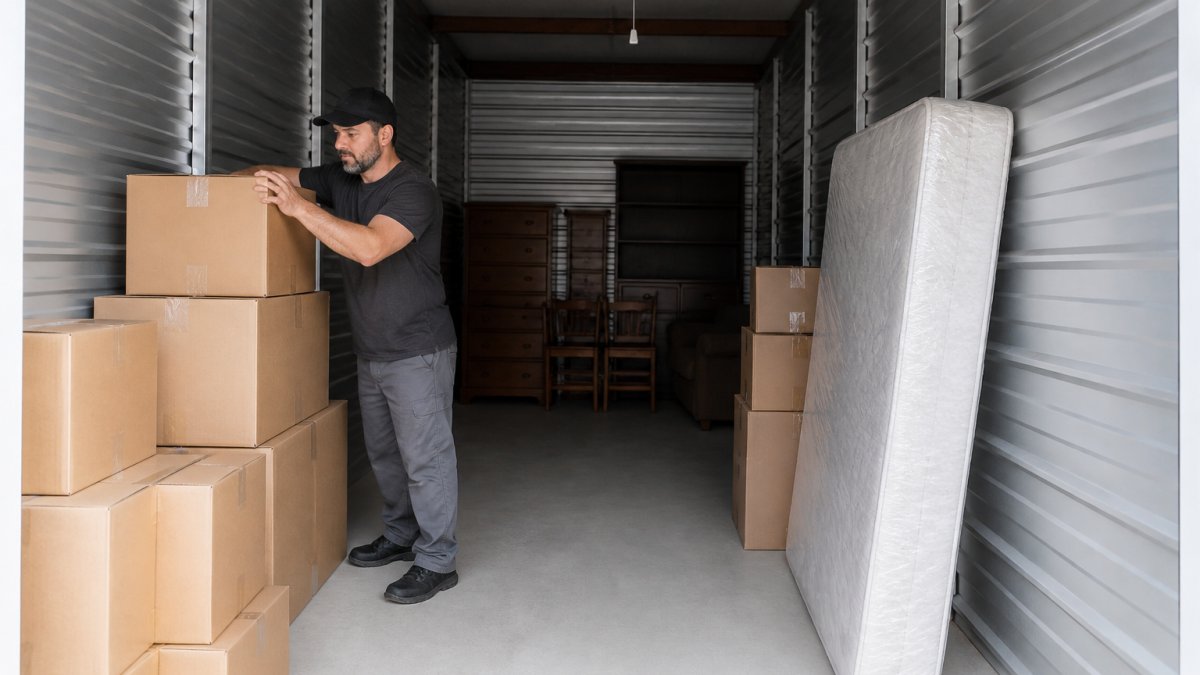
Good packing stretches a unit's usable space and protects what's inside: heavy items low, fragile items high, a clear path to anything you'll need first, and nothing stacked in a way that can fall.
Layout Planning Before You Lift a Box
Plan the floor before you load it. A simple layout saves more space than any packing trick:
- Map the unit on paper. Sketch the door, the walls, and any posts or obstructions. Mark where large furniture will go and where the aisle will run.
- Place furniture first. Put couches, dressers, and shelving along the back and side walls, leaving the center open.
- Reserve the front for frequent items. Whatever you will need first goes nearest the door, at waist height.
- Run the aisle down the long axis. In a 10x20 or larger, a center aisle with goods loaded on both sides beats a perimeter pile every time.
- Keep the door swing clear. Leave enough space inside the door to step in and set down a box without tripping.
Stacking, Weight Limits, and Safety
Not all floor-to-ceiling space is usable; treating it that way causes injuries and damaged belongings.
- Heavy on the bottom, light on top. Load dense boxes, tools, and equipment at floor level. Put lightweight and fragile items higher.
- Do not stack above shoulder height if you will need the item soon or if the stack is unstable. Tall stacks of heavy boxes are a falling hazard.
- Respect weight limits. Facilities set floor-load and shelving limits, and some prohibit storing certain heavy equipment or hazardous materials.
Boxes, Labels, and Inventory
Label the sides of boxes, not the tops, you read labels from the aisle. Keep a written or photographed inventory of what's in each box and roughly where it sits; that list speeds retrieval and supports an accurate declared value for any protection plan.
Wrap mattresses in plastic, disassemble bed frames, and stand couches on end to free floor space. Use uniform box sizes where possible so stacks interlock cleanly.
When Packing Reveals You Need a Different Size
If your planned layout won't fit with a usable aisle, stack higher within safety limits, switch to a larger unit, or move overflow into a second small unit. Ask about mid-lease transfers before you commit, a transfer fee is usually far less than moving everything twice.
Cost, Climate, and Access: The Trade-Offs That Decide the Size
Size isn't the only lever. Rental rate, climate control, and access frequency all change which unit makes sense, and they interact. A cheap 10x20 can cost more over a year than a slightly smaller climate-controlled unit if humidity ruins a wood dresser, so price the whole rental, not just the monthly sticker.
What Actually Drives Your Total Rental Cost
Monthly rent is rarely the whole bill.
- Base rent by size and location. A 10x10 in a climate-controlled building typically rents for more per square foot than a standard 10x10, and units near the loading bay or elevator often carry a premium. Rates also move with occupancy, the same unit can be priced differently in summer versus winter.
- Administrative and deposit charges. Many facilities collect a one-time admin fee and a refundable cleaning or security deposit at signing. Ask whether the deposit is refundable and what conditions trigger a deduction.
- Insurance or protection plan. Facilities generally require proof of coverage, either through a renter's or homeowner's policy or a plan sold on site. The monthly protection charge scales with the declared value of your belongings, so an accurate inventory also keeps this cost honest.
A practical rule: compare the first-month total and the twelfth-month total side by side. A unit that looks cheaper per month can lose that advantage once admin fees, protection plans, and a mid-year increase are counted.
Climate Control: Match the Unit to the Belongings, Not the Square Footage
Climate control changes what you can safely store and therefore how much you need to keep. Standard units suit tools, bikes, lawn equipment, plastic totes, and durable goods. Climate-controlled units, which moderate temperature and humidity swings, are the safer choice for:
- Wood furniture and antiques, which can warp, crack, or delaminate when humidity swings.
- Electronics and appliances, where condensation and heat shorten service life.
- Documents, photos, and artwork, which are sensitive to moisture and heat.
If most of your inventory is sensitive, a smaller climate-controlled unit is often the better buy than a larger standard unit, you're paying for protection, not square footage. If only a few items are sensitive, store those at home and put the durable goods in a standard unit.
Access Frequency Changes the Size You Need
How often you visit should influence size as much as volume does. A unit you visit weekly needs aisle space and shelving to reach common items; one you visit once a season can be packed densely floor to ceiling.
Ask yourself three questions before you sign:
- How often will I retrieve items? Weekly visits justify a walkway and a larger unit; annual visits do not.
- Will I add or remove items over time? If the inventory will grow, leave headroom now rather than paying for a second move later.
- Do I need drive-up or ground-floor access? Units that open directly to a drive aisle cost more but save labor on every visit; upper-floor or interior units are cheaper but slower to load.
For anything valuable or water-sensitive, ask how the facility handles moisture, pest control, and security. A dependable facility will answer plainly, and that answer tells you as much as the price does. Red D Stor keeps the rental process simple and the terms clear, so you know what you're getting before you sign.
Conclusion
Picking a unit still feels like guesswork for most renters. Measure your belongings, match the volume to a size chart, and let access and climate needs settle the rest.
Red D Stor makes that decision easier with a secure facility, a straightforward rental process, and clear answers about sizing before you commit. Bring your inventory list and we'll help you find the right fit, whether that's a 5x5 for seasonal gear or a 10x30 for a whole household.
Frequently Asked Questions
Should I get a 10x10 or 10x15 storage unit?
A 10x10 unit holds about 100 square feet, roughly the contents of a one-bedroom apartment: a mattress set, dresser, couch, and 15 to 20 boxes. A 10x15 adds 50 square feet and fits a two-bedroom home or a one-bedroom plus a home office. If you are storing appliances, a dining set, or business inventory alongside furniture, the 10x15 gives you the walkway and stacking room the 10x10 will not. When the inventory sits between the two, rent the larger unit for the first month and downsize after you see how much space is left.
How do I estimate what size storage unit I need?
List your belongings room by room, then group them by how much floor space each item occupies when stacked. A couch takes about 3 feet by 7 feet, a queen mattress about 5 by 7, and a standard box about 1.5 by 1.5. Add up the footprint, then add 20 to 30 percent for walkways and access. Compare that total against the square footage in a storage unit size chart. Reading the chart without an inventory is the most common reason people rent a unit that is too small.
What size storage unit do I need for a one-bedroom apartment?
Most one-bedroom apartments fit in a 5x10 or 10x10 unit. A 5x10 holds the basics: a mattress, a small couch, a dresser, and about 10 boxes. A 10x10 fits a full one-bedroom, including a dining table, bookshelf, and 15 to 20 boxes. If the apartment has a washer and dryer or a large sectional, plan on the 10x10. Bring a written inventory to the facility so staff can confirm the fit before you sign.
Should I rent a larger unit if I need frequent access to my belongings?
Yes, when you visit weekly or more. A larger unit lets you keep a clear walkway to the items you use most and leave the back wall for long-term storage. If you only need access once a season, pack tight and save money on a smaller unit. Tell the facility how often you plan to visit; access frequency is one of the main reasons people upgrade a size after the first month.