 How-to
How to Avoid Hidden Fees in Storage Rentals
Last Updated: November 14, 2026
Quick Summary
To avoid hidden fees in storage rentals, ask for a written, itemized fee schedule before you reserve and confirm the full monthly cost including every recurring charge. Compare quotes on total cost, not the advertised rate, and check the contract for rate-increase, protection plan, late fee, and notice terms.
- Ask each facility for the same six data points and compare total cost, not the headline rate.
- Confirm how long the introductory rate lasts and what the standard rent becomes after it ends.
- Check whether a protection plan is required and whether you can substitute your own insurance policy.
- Confirm the notice period, prorating rule, lock-removal fee, and cleaning standard before signing.
- Request any unclear clause explained in plain language and in writing before you sign.
Table of Contents
- The Hidden Fees That Drive Up Storage Rental Costs
- Questions to Ask Before Renting a Storage Unit
- Your Storage Rental Contract Checklist
- How to Compare Storage Unit Prices Beyond the Advertised Rate
- Storage Unit Introductory Rates and What Happens After Them
- Late Fees, Autopay, and Payment Processing Charges
- Cancellation, Notice, and Move-Out Requirements
- The Move-In-to-Move-Out Cost Worksheet
- How to Challenge an Unexpected Charge or Rent Increase
- Reserving a Unit With a Fee Schedule You Can Verify
- Frequently Asked Questions
The Hidden Fees That Drive Up Storage Rental Costs
The advertised rate is rarely the number you pay. Storage rentals often carry add-on charges that only appear at signing, and those extras can push your real monthly cost well above the sign out front. Below, we break down every fee category, show you what to ask, and give you a worksheet to compare quotes honestly.
The core problem is simple. Operators quote a promotional rate, then layer on protection plans, admin charges, and rate increases. None of that is illegal, but it is easy to miss if you do not know where to look.
The Most Common 'Hidden' Fee Categories
Most surprise charges fall into a handful of buckets:
- One-time fees: admin, setup, and move-in charges
- Recurring fees: protection plans, processing charges, and rate adjustments
- Conditional fees: late payments, lockouts, and move-out charges
- Promotional terms: introductory rates that reset after a set period
A common mistake is treating the monthly rent as the whole cost. In practice, the total cost is rent plus every recurring charge plus any one-time fees spread across your stay.
Administrative, Setup, and Account Fees
These are charged once, usually at move-in. They cover paperwork and account creation.
Ask for each one in writing:
- Administrative fee: a flat charge to open your account
- Setup fee: covers lock, cleaning, or unit prep
- Account fee: some operators bill a small recurring charge for billing itself
A setup fee is not automatically a red flag. What matters is whether it was disclosed before you reserved. If a fee appears for the first time on the final agreement, that is your signal to slow down and ask questions.
Questions to Ask Before Renting a Storage Unit
Before you sign anything, get clear answers to a short list of questions. These are the ones that separate a fair deal from an expensive one.
- What is the full monthly cost, including every recurring fee?
- Which charges are one-time, and which repeat each month?
- How long does the introductory rate last, and what does rent become after?
- Is a protection plan required, and can I use my own insurance instead?
- How much notice do I need to give before moving out?
- What triggers a late fee, and how is it calculated?
- Can I pay by autopay, and is there a processing charge for it?
- Are there any move-out charges or cleaning fees?
Write the answers down. A verbal "don't worry about it" is not a term you can hold anyone to later.
Your Storage Rental Contract Checklist
A storage rental agreement is the legal document that sets your rent, fees, and notice terms for the whole lease. Read it before you sign, and check these items line by line:
- Monthly rent and the exact date it is due
- Every one-time fee, itemized
- Every recurring fee, itemized
- The protection plan terms and whether it is mandatory
- The late fee amount and grace period
- Notice period required to move out
- How and when rent can increase
- Move-out condition requirements
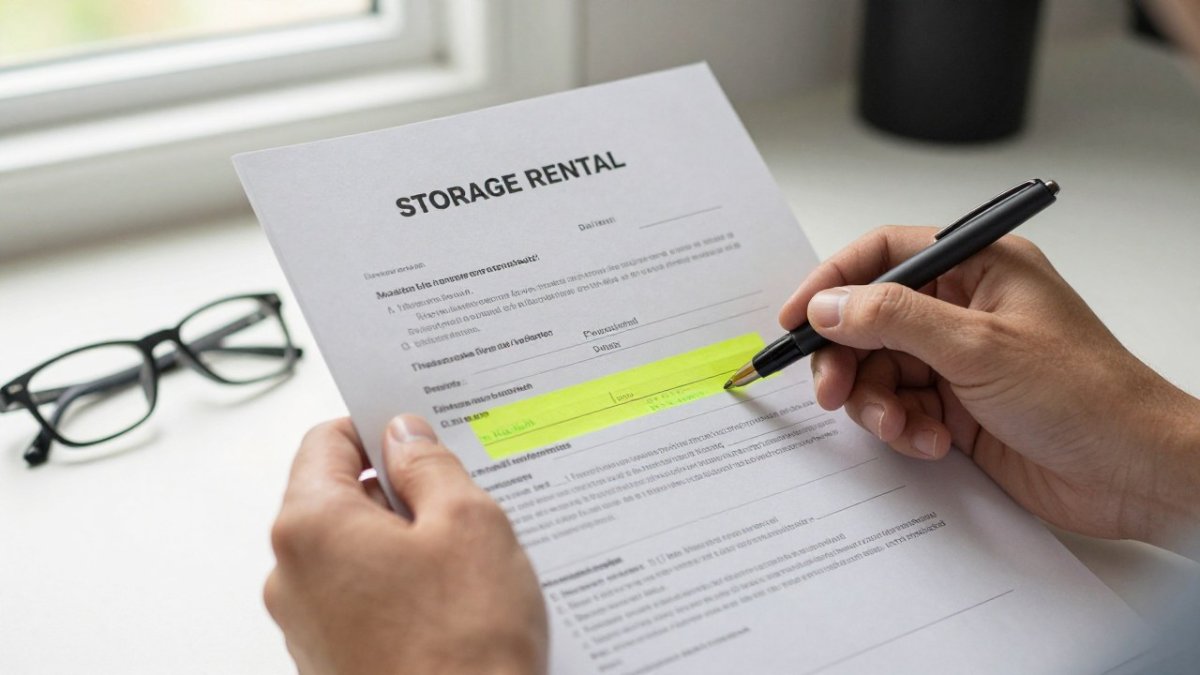
A checklist only helps if you know what the clauses actually say. Below are the specific contract terms to locate and the language patterns that should make you slow down.
Rent and fee schedule. Find the section labeled "Rent," "Charges," or "Fee Schedule." Confirm that the monthly rent matches your quote and that every add-on is listed with a dollar amount, not a range. A common pattern is a clause that says fees "may include" certain charges without listing amounts. That language gives the operator room to add fees later. Ask for a written, itemized schedule attached to the agreement.
Escalation and rate-change clause. Look for words like "adjust," "increase," "modify," or "at our discretion." Note the notice period required before a rent change and whether the clause caps the increase. If the clause says rent may change "upon notice" with no cap, budget for an increase and ask what the typical annual adjustment has been at that facility.
Protection plan or insurance clause. Find whether coverage is "required," "optional," or "conditionally required." If the agreement says coverage is required but does not state that you may substitute your own policy, ask for that right in writing before signing.
Late fee and default clause. Confirm the grace period, the flat late fee, and whether any daily or per-day charge applies after the grace period. Also check what triggers a "default" and whether default accelerates the full remaining balance.
Notice and termination clause. Note the exact notice period, the required form of notice (written, email, portal), and whether notice must be given before a specific billing date. Check whether the agreement auto-renews and what happens if you miss the notice window.
Lien and lockout language. Most storage agreements include a lien clause allowing the facility to lock you out and eventually sell contents for unpaid rent. Confirm the notice the facility must give before a lockout and the cure period to pay.
Watch out: A clause that references "the fee schedule available at the office" instead of listing amounts in the agreement itself means the numbers can change without a contract amendment. Ask for the current schedule as a signed attachment.
If a clause is unclear, ask for it in plain language and request the explanation in writing. For a deeper walkthrough of what to check before signing, see our guide to storage unit rental agreement tips.
How to Compare Storage Unit Prices Beyond the Advertised Rate
Comparing storage unit prices means comparing total cost, not the number on the sign. Two units at the same advertised rate can cost very different amounts once fees are added.
Use this quote-comparison method:
| What to Compare | Why It Matters |
|---|---|
| Advertised rate | The starting number, not the final one |
| Recurring fees | Added to every month you stay |
| One-time fees | Spread across your rental period |
| Protection plan | Often the largest add-on |
| Rate-increase terms | Determines your cost after month one |
| Notice period | Affects your exit flexibility |
Call each facility and ask for the same six data points. Put them side by side. The lowest total wins, not the lowest headline rate. Our guide on how to compare storage unit prices covers short-term options in more detail.
Storage Unit Introductory Rates and What Happens After Them
An introductory rate is a discounted rent offered for the first few months of a lease. It is a marketing tool, and it usually expires.
The important question is what happens next. Ask:
- How many months does the promotional pricing last?
- What is the standard monthly rent after it ends?
- Is there a price lock, or can rent change at any time?
A promotional rate is fine if you know the reset date and the new amount. It is a problem when the increase is a surprise.
Monthly Rent Increases and Rate Changes
Many agreements allow the operator to adjust rent with notice, but the terms vary widely.
Check three things: how much notice they must give, how often increases can happen, and whether your agreement caps them. If the contract is silent on limits, assume rent can rise. Budget for it, and keep your notice period in mind so you are never stuck paying a rate you did not agree to.
Late Fees, Autopay, and Payment Processing Charges
Payment terms hide small costs that add up. Late fees are the obvious one, but processing charges and autopay rules matter too.
- Late fee: charged when rent arrives after the due date; confirm the amount and grace period
- Autopay: convenient, but confirm the exact debit date
- Processing fee: some operators add a charge per payment, by card or online
- Payment method rules: cash, check, and card may be treated differently
Set a reminder a few days before your due date, even with autopay. A declined card can trigger a late fee through no fault of your own.
Cancellation, Notice, and Move-Out Requirements
Move-out terms decide how cleanly you can leave, and they are where the least-discussed charges hide. Most agreements require written notice, often a set number of days before your next billing date. The mechanics matter more than the headline rule.
Notice deadlines and the billing cycle. A "10-day notice" usually means 10 days before your next rent due date, not 10 days before you vacate. If you give notice on the 5th and rent is due on the 1st, you may owe the following month even though the unit is empty. Confirm three things in writing: the number of days, the date the clock starts, and the accepted delivery method (email, portal, certified mail, or in-person form).
Prorating. Ask whether a partial month is prorated or charged in full. Many operators charge the full month regardless of move-out date, while others prorate only if notice was timely. Get the rule in writing before you sign, because it changes the cost of leaving early.
Lock removal and unit condition. If you leave a lock on the unit, the facility may charge a lock-removal fee and may require you to be present for the removal. Confirm whether you must remove your own lock, whether the facility removes it, and what the charge is. Also confirm the condition standard: swept clean, no debris, no abandoned items. A cleaning or disposal fee can apply if the unit is not emptied to their standard.
Abandonment versus move-out. If you stop paying without giving notice, the agreement may treat the unit as abandoned, which can trigger lien procedures, additional fees, and a longer obligation. A written notice is what separates a clean exit from an abandonment file.
Early-termination charges. Some agreements charge a cancellation or early-exit fee, sometimes equal to one month's rent. Check whether the fee applies only to fixed-term leases or also to month-to-month rentals.
Final bill and deposit refund. Ask when the final statement is issued, how the deposit is refunded, and what deductions are allowed. Confirm the refund timeline and the method (check, card credit, or account credit).
Watch out: A notice delivered by phone or in casual conversation is usually not valid. If the agreement requires written notice, a verbal heads-up does not stop the next month's rent from accruing.
If flexibility matters, read our guide on how to rent storage without long contracts before you commit. For a full picture of exit costs, add the notice period, prorating rule, lock-removal fee, and cleaning standard to the cost worksheet below.
The Move-In-to-Move-Out Cost Worksheet
Here is a simple worksheet to estimate your true total. Fill it in for each facility you consider.
| Cost Item | Amount | One-Time or Monthly |
|---|---|---|
| First month rent | $____ | Monthly |
| Admin/setup fee | $____ | One-time |
| Security deposit | $____ | One-time (refundable) |
| Protection plan | $____ | Monthly |
| Processing fee | $____ | Monthly |
| Expected months of rental | ____ | Total period |
| Estimated total | $____ | Sum all items |
Multiply monthly charges by your expected months, then add the one-time fees. The result is your real cost. Compare that number across facilities, not the advertised rate.
How to Challenge an Unexpected Charge or Rent Increase
If a charge shows up that you did not agree to, act quickly and in writing.
- Find the clause. Locate the term in your signed agreement that covers the charge.
- Ask for an itemized bill. Request the charge in writing with its basis.
- Put your dispute in writing. Email or letter, with dates and amounts.
- Cite your agreement. Quote the relevant clause back to them.
- Escalate if needed. Ask for a manager, then follow up in writing again.
Many disputes are resolved at step two. Keep every record. If the increase or charge conflicts with your signed terms, your contract is your best evidence.
Reserving a Unit With a Fee Schedule You Can Verify
The final step is reserving with confidence. Ask for a written fee schedule before you pay anything, and confirm it matches what you were quoted.
Red D Stor offers secure self-storage with a straightforward rental process in New Philadelphia, OH. Contact the facility directly for current fee details and a quote.
Ready to reserve? Follow our storage unit rental process steps to see what to expect, then reach out to Red D Stor for current pricing and availability.
Storage rentals reward the prepared renter. The operators who disclose every fee are the ones worth your business, and the contract is where you confirm it. Red D Stor offers a simple, flexible rental process, a secure facility, and clear communication from your first question to your move-out. Get started with Red D Stor and rent with a fee schedule you can verify before you sign.
Frequently Asked Questions
Do storage units have hidden fees?
Yes, storage rentals often carry charges beyond the advertised monthly rent. Common ones include an administrative or setup fee at move-in, a mandatory tenant protection plan, late-payment fees, and payment processing charges for autopay or card payments. Some facilities also bill a cancellation fee or a cleaning charge at move-out. None of these are necessarily improper, but they should appear in the fee schedule of your rental agreement. Ask for that schedule in writing before you sign so the total cost is clear.
What fees should I ask about before renting a storage unit?
Ask about the administrative or setup fee, the deposit amount and what it covers, whether a tenant protection plan is required and what it costs monthly, late fee amounts and grace periods, and any payment processing fee. Also ask how much notice you must give to move out, whether a cancellation fee applies, and how rate increases are handled. Request the full fee schedule alongside the rental agreement so you can compare the total cost, not just the advertised rate.
Do storage units raise prices after the introductory rate?
They can. Promotional or introductory rates often apply for a limited period, after which the monthly rent moves to a standard rate. Beyond that, many rental agreements allow periodic rate adjustments with written notice. The contract should state how much notice the operator gives and whether any price lock applies. Ask what the standard rate is before you sign, and note the notice period so a rate increase does not catch you off guard.
Is insurance required when renting a storage unit?
Many facilities require some form of coverage, either a tenant protection plan sold by the operator or proof of your own renters or homeowners policy that extends to stored items. Costs and coverage limits vary, so ask whether the plan is mandatory, what it pays for, and whether you can opt out by showing your own policy. Confirm in writing what the facility covers, since the rental agreement usually states that stored belongings are your responsibility.